
How a rising star at a top Thai bank's $100m Web3 fund used fake crypto deals to swindle investors
A crypto native venture capitalist in Thailand raised millions in personal deals on the promise of elite token allocations. And then he vanished.


On stage at the Singapore FinTech Festival in late 2024, Kampanat Vimolnoht looked exactly like what he claimed to be: a crypto-savvy venture capitalist helping to bring institutional investment to companies working in emerging technology.
Known to friends and colleagues as Jom, he wore a black company T‑shirt under a tailored blazer, hair neatly parted at the side and posture relaxed. The former professional musician spoke at length about his decade-long experience advising startups, serving on a government tech advisory committee, supporting joint ventures and helping companies expand internationally.
“Sounds like a fantastic track record,” the moderator replied.
Vimolnoht smiled.
With a masters degree in investment analysis from a university in the UK and a keen interest in crypto, he was now working at his fourth fund, KXVC. Announced the previous year, it was a $100 million Web3 and AI fund under Kasikornbank, one of Thailand’s largest financial institutions. To many, he seemed like a typical insider.
And in crypto, insiders get the allocations.
Token deals
In the opaque world of early‑stage crypto investing, access is everything.
Before a token launches publicly, projects often sell private allocations to select investors. These deals grant the right to purchase tokens at early prices, usually subject to vesting schedules that lock them for months or years. When a token lists on exchanges and surges, early buyers can see dramatic returns.
Despite crypto’s rhetoric about democratisation and transparency, the most lucrative opportunities rarely circulate publicly. They move through private Telegram chats, WhatsApp groups and investor networks. Access tends to cluster around venture funds, founders, social media influencers and those who sit at the centre of ecosystems.
Vimolnoht, it seemed, was one of those privileged few with access. According to multiple people Scamurai spoke with, he offered friends and associates access to what he described as his personal allocations in sought after projects, including Monad, Babylon and Linera. In some cases, the companies overlapped with firms KXVC had publicly backed, reinforcing the impression that he was operating within real channels, albeit ones that opened him up to the accusation of insider trading.
Over and over again, he told a similar story, collected funds from people, provided contracts and then invited them to join more investments as they waited for earlier ones to unlock.
And then, in November last year, he vanished.
Excuses
Mark, an executive at a regional payment company based in Bangkok, first met Vimolnoht in 2017, when the latter was a junior analyst at a local venture firm. He remembers him as polite and eager.
“He was a very nice person,” Mark said. They stayed in touch over the years as both advanced in their careers.
Investors Scamurai interviewed, including Mark, asked to use pseudonyms either due to fear of reprisals for speaking out from employers that had relationships with Vimolnoht, or because of concerns about publicly disclosing having made large investments in crypto. Each sent Scamurai documentation backing up their story, including screenshots of conversations, police reports, bank transfer statements, contracts sent by Vimolnoht and blockchain transaction hashes.
When Vimolnoht began sharing crypto investment opportunities, the approach felt genuine. He sent project decks, token allocation agreements and payment instructions. The paperwork appeared professional. The deals aligned with market trends.
“I invested in several projects he brought to the table,” Mark said. “In total, more than a million dollars.”
Because tokens were locked under vesting schedules, there was no expectation of immediate returns. Months passed and Vimolnoht brought new opportunities to Mark. Then, in October last year, some of the earliest investments were due to reach their vesting milestones. That was when the tone changed.
“He started giving me excuses,” Mark said. Delays were blamed on administrative processing, market conditions and issues with counterparties. The explanations shifted. At one point, Vimolnoht suggested that he himself had been scammed on certain allocations.
“It didn’t make sense,” Mark said. “The stories kept changing.”
By early November, communication stopped entirely. Only then did a more unsettling question emerge: what if the allocations had never existed at all?
Mark reviewed the contracts he had received. He now believes they were fabricated and are edited versions of actual KXVC documents. He filed a police report. Soon after, he learned he was not alone.
The pattern
Scamurai is aware of at least two dozen individuals that have had similar experiences with Vimolnoht. The total amount lost isn’t clear and the range people individually invested with him is wide, between just shy of $20,000 to over $1,000,000.
Another Bangkok-based investor, who formerly worked with Vimolnoht, said he too was invited into private blockchain investment opportunities.
“He used the credibility derived from his work position,” the investor, who sent $96,500 to Vimolnoht, said.
But when he too started to doubt the veracity of the deals, he began contacting project founders directly. The responses were alarming. Monad described the contracts he shared as fraudulent. Another supposed investment, Datagram, denied any relationship. The founder of Linera said Vimolnoht had expressed interest but had not invested yet.
Scamurai contacted a total of 19 projects which Vimolnoht claimed to be working with. Those that responded either had no association with him or had spoken to him informally but had not granted the allocations he claimed. Among them, Babylon said it had “never dealt with, nor had any association, with that individual”.
Another founder described the situation as “deeply ironic considering how hard it was to raise capital and here’s this dude running around scamming people who really just wanted to invest in my company.”
Vimolnoht’s scheme was not limited to targets in Thailand, either. Investors in Singapore, Vietnam, the U.S. and beyond reported parallel stories.
Steven, who runs a California‑based firm serving crypto clients, was introduced through a mutual contact. He said he initially sent roughly $15,000 in USDC. Documentation followed. “There were no red flags,” he said.
At one point, Vimolnoht proposed early private sales of allocations to him, requiring additional processing fees. “At that point, I didn’t have a reason to be suspicious,” Steven said.
Steven paid them. Later came another request for $2,400, allegedly needed because Vimolnoht could not access his wallets while travelling. He paid that too.
Shortly after the final transfer, the messages stopped. “I had a sleepless night,” he said. “I think I’m out about $130,000 — basically my life savings in crypto.”
The employment question
Complicating matters further was Vimolnoht’s employment status. Multiple investors said they believed he remained managing director at KXVC when they sent funds. However, he had been terminated from the firm in March 2025. He has since deleted KXVC from his CV on LinkedIn.
“I assumed he was still with KXVC,” said Megan, a founder of another Southeast Asian crypto project, who invested $18,000 with him across four deals. On one deal, she was given a $3,000 refund from him, meaning she is now down $15,000. “He’d been in the space for so long.”
Megan, who has been in contact with many of the other victims, estimated cumulative losses reaching into the millions of dollars. Some payments were made via traditional bank transfers, others moved on‑chain.
One wallet where Steven deposited some of the funds was created in late July 2025 and initially funded via an OKX exchange deposit. Over subsequent months, it recorded 174 token transactions — 80 incoming and 94 outgoing — largely in dollar‑denominated stablecoins and totalling some $1.71 million in funds. It is not clear how many of those are related to the fake investments. The last activity was in October.
A good reputation
Those who knew Vimolnoht still struggle to reconcile the public persona with the allegations.
“He never had a bad reputation,” Mark said. “He worked at multiple VCs. He spoke on panels in Thailand, the U.S. and Europe. It’s hard to understand.”
Speculation circulates as to what drove him, whether it was financial pressure, personal issues or simply opportunism. None of the victims know for certain, although one said that prior to cutting contact he had asked about how to conduct background checks into people.
An attempt to reach Vimolnoht for comment via LinkedIn went unanswered. His Telegram account, with which he communicated with many victims, has been deactivated. Several sources suggested that Vimolnoht left Thailand and may be in the U.S., but Scamurai could not independently verify this.
KXVC also did not respond to multiple requests for comment. The venture firm has however posted a note on its website that Vimolnoht no longer works there, which victims said is in response to them demanding KXVC do so. It also warns on its homepage about an impersonator “soliciting investor funds to be placed in his personal account”, which may refer to Vimolnoht.
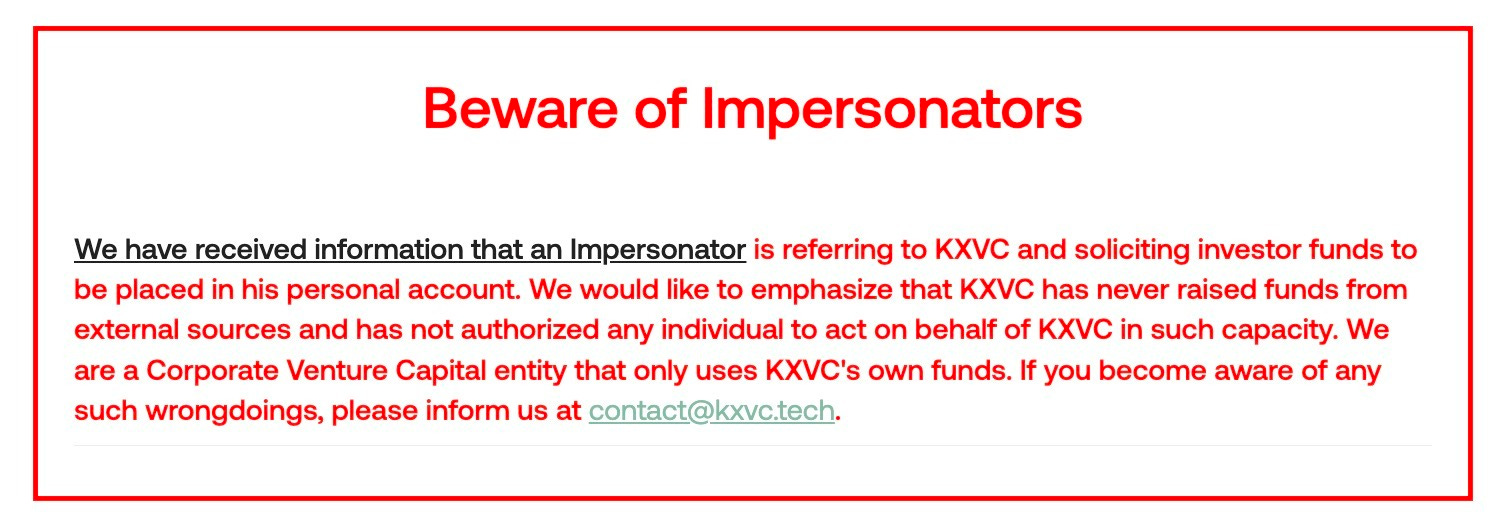
“We would like to emphasise that KXVC has never raised funds from external sources and has not authorised any individual to act on behalf of KXVC in such capacity. We are a Corporate Venture Capital entity that only uses KXVC’s own funds,” it stated.
Scams in crypto are nothing new. Billions of dollars are lost annually to investment scams, pig butchering, pump-and-dumps and other schemes. But Vimolnoht’s case is unusual in that he sacrificed years of built-up reputation in a fraud that was sure to unravel once the lock-up period on the tokens ended.
“He built up a relationship,” Steven said. “We did small deals. We talked regularly. I thought it was legitimate.” He paused. “And it ended up being a complete scam.”